Content and Structure
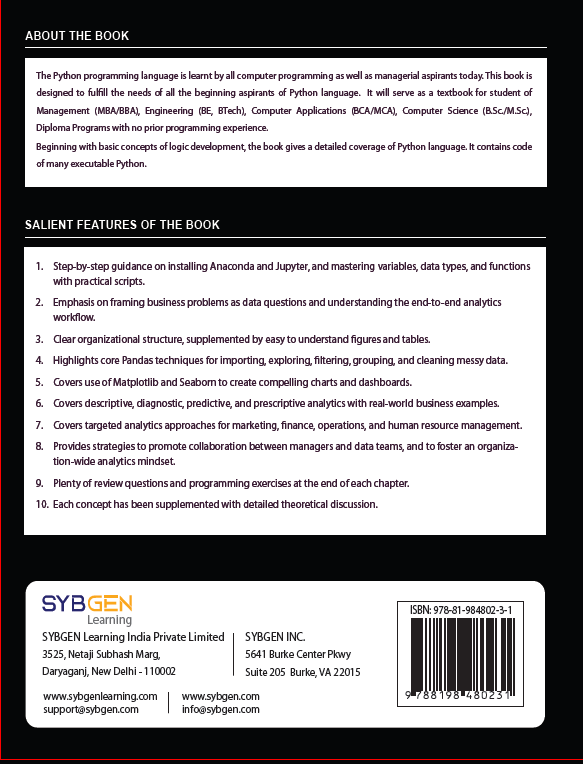
The book is divided into 5 parts consisting of 16 Chapters starting from basic concepts of Python programming to how it can be used in various domains for data analytics.
Part I: Foundations
Chapter 1. Thinking Like an Analyst: Focuses on developing structured analytical thinking, teaches readers how to frame business problems as data questions, and provides an overview of a typical analytics workflow.
Chapter 2. Introduction to Data Analytics for Managers: Explains the value of data analytics in modern business, highlights the expanding role of Python, and reassures readers that no prior coding background is necessary to start learning analytics for managerial decision-making.
Chapter 3. Getting Started with Python: Guides readers through installing Anaconda and Jupyter, introduces key Python basics such as variables, data types, and functions, and concludes with writing a simple script to solidify basics.
Part II: Working with Data
Chapter 4. Data Structures in Python: Introduces lists, dictionaries, and DataFrames, demonstrates their use through business cases, and prepares readers for handling business data using Python’s flexible structures.
Chapter 5. Data Analysis with Pandas: Covers techniques to import and explore datasets, filter and group data, and manage missing or messy information using Pandas, key skills for effective business analysis.
Chapter6. Data Visualization for Insight: Teaches the basics of Matplotlib and Seaborn libraries, illustrating how to create meaningful charts and dashboards that help managers communicate data-driven stories.
Part III: Applied Analytics for Managers
Chapter 7. Descriptive Analytics: Explores key business metrics such as KPIs, averages, and trends, introducing summary statistics in Python to provide actionable descriptive insights.
Chapter 8. Diagnostic Analytics: Reveals techniques for root cause analysis, and pattern and correlation discovery to support in-depth business diagnostics.
Chapter 9. Predictive Analytics: Introduces basic machine learning concepts, demonstrates forecasting using linear regression, and presents practical business use cases like sales and churn prediction without requiring advanced mathematics.
Chapter 10. Prescriptive Analytics and Decision-Making: Discusses scenario analysis, “what-if” modeling, and optimization concepts for enhancing managerial decision-making using prescriptive analytics in Python.
Part IV: Business Applications
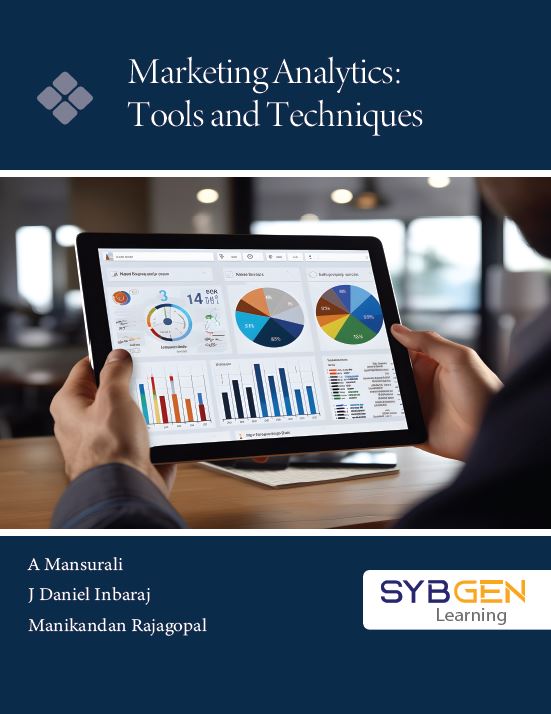
Chapter 11. Marketing Analytics: Focuses on customer segmentation and campaign analysis using quantitative and qualitative data to inform marketing strategies.
Chapter 12. Finance and Operations: Explains how to measure and forecast financial KPIs and tackles inventory and supply chain analytics with practical Python applications.
Chapter 13. Human Resource and People Analytics: Covers attrition analysis and productivity metrics to help managers derive insights from workforce data for better human capital decisions.
Part V: Strategy and Execution
Chapter 14. Building a Data-Driven Culture: Discusses best practices for collaborating with data teams, asking the right business questions, and effectively communicating findings to stakeholders for cultural change in organizations.
Chapter 15. Automating Reports and Dashboards: Demonstrates how to leverage Python for report automation, including connecting analytics results to Excel and Google Sheets for efficient manager workflows.
Chapter 16. Ethics, Privacy, and Responsible Data Use: Outlines key principles of data governance, ethical analytics, and fairness to ensure responsible use and interpretation of data in business analytics.