




Description
Large Language Models (LLMs) are transforming the way individuals and organisations interact with technology, information, and knowledge. As these models become increasingly capable, the ability to communicate with them effectively is emerging as an important skill across education, research, business, and technology. Prompt engineering provides a structured approach to this interaction, moving beyond simple questions and instructions towards the deliberate design of prompts, workflows, and intelligent AI-powered systems.
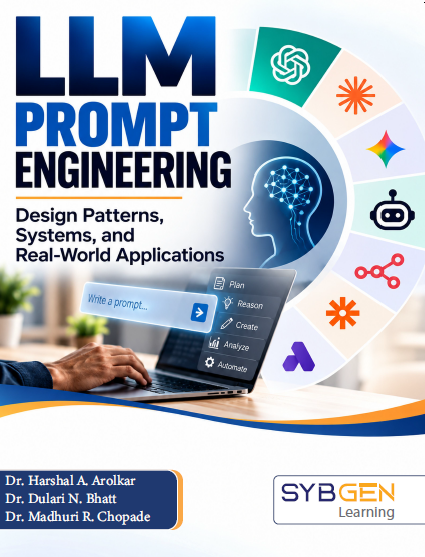
This book, LLM Prompt Engineering: Design Patterns, Systems, and Real-World Applications, has been developed to provide readers with both a conceptual foundation and a practical understanding of prompt engineering. It begins with the fundamentals of LLMs, including tokens, transformers, and model behaviour, before progressing towards systematic prompt design and advanced prompting techniques.
The book treats prompts as programmable interfaces that can be designed, tested, evaluated, refined, and optimised. It explores techniques such as decomposition, structured reasoning, reflection, interactive prompting, and other design patterns for addressing complex tasks. It also extends beyond individual prompts to examine Retrieval-Augmented Generation, embeddings, orchestration frameworks, fine-tuning, and the development of scalable LLM-powered applications.
Particular emphasis is placed on real-world applications in enterprise automation, coding, data analytics, and document processing. The book also considers evaluation, safety, reliability, and governance, recognising that effective AI adoption requires both technical capability and responsible implementation.
Through practical examples, hands-on activities, experiments, frameworks, and projects, this book aims to help students, professionals, researchers, and practitioners develop the confidence to design meaningful LLM solutions and translate generative AI capabilities into measurable and sustainable outcomes.
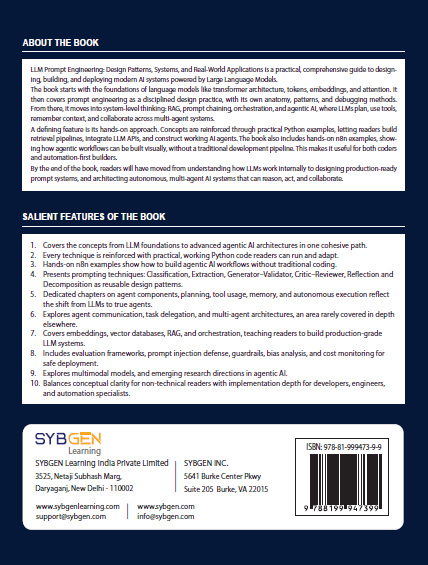
Salient Features of the Book:
- Foundations of Large Language Models
Builds a strong conceptual understanding of LLMs, including tokens, transformers, model behaviour, and the principles underlying modern generative AI.
- Prompt Engineering Mindset
Develops a systematic approach to prompting by treating prompts as programmable interfaces that can be designed, tested, refined, and optimized.
- Anatomy of Effective Prompts
Explains the essential components of a high-quality prompt and provides practical guidance for creating clear, contextual, and goal-oriented instructions.
- Fundamental Prompting Techniques
Covers core prompting approaches and techniques that help users obtain more accurate, relevant, consistent, and useful outputs from LLMs.
- Advanced Prompt Design Patterns
Explores advanced methods such as decomposition, structured reasoning, chain-of-thought approaches, and reflection-based prompting for complex tasks.
- Interactive and Dynamic Prompting
Introduces techniques for creating adaptive prompts that respond to changing contexts, user inputs, and evolving task requirements.
- Building LLM-Powered Systems
Provides practical guidance on developing scalable LLM applications using embeddings, Retrieval-Augmented Generation (RAG), and orchestration frameworks.
- Fine-Tuning and Model Adaptation
Explains how LLMs can be adapted and customized for specialized tasks, domains, and organizational requirements through model adaptation techniques.
- Real-World Professional Applications
Demonstrates practical applications of prompt engineering across enterprise automation, coding workflows, data analytics, document processing, and other professional contexts.
- Evaluation, Safety and Governance
Addresses the evaluation, reliability, safety, responsible use, and governance of LLM-based systems while providing frameworks and best practices for sustainable AI adoption.